
Risk-Based Testing
Prioritize testing effort based on risk - focusing on the features most likely to fail and most damaging when they do.
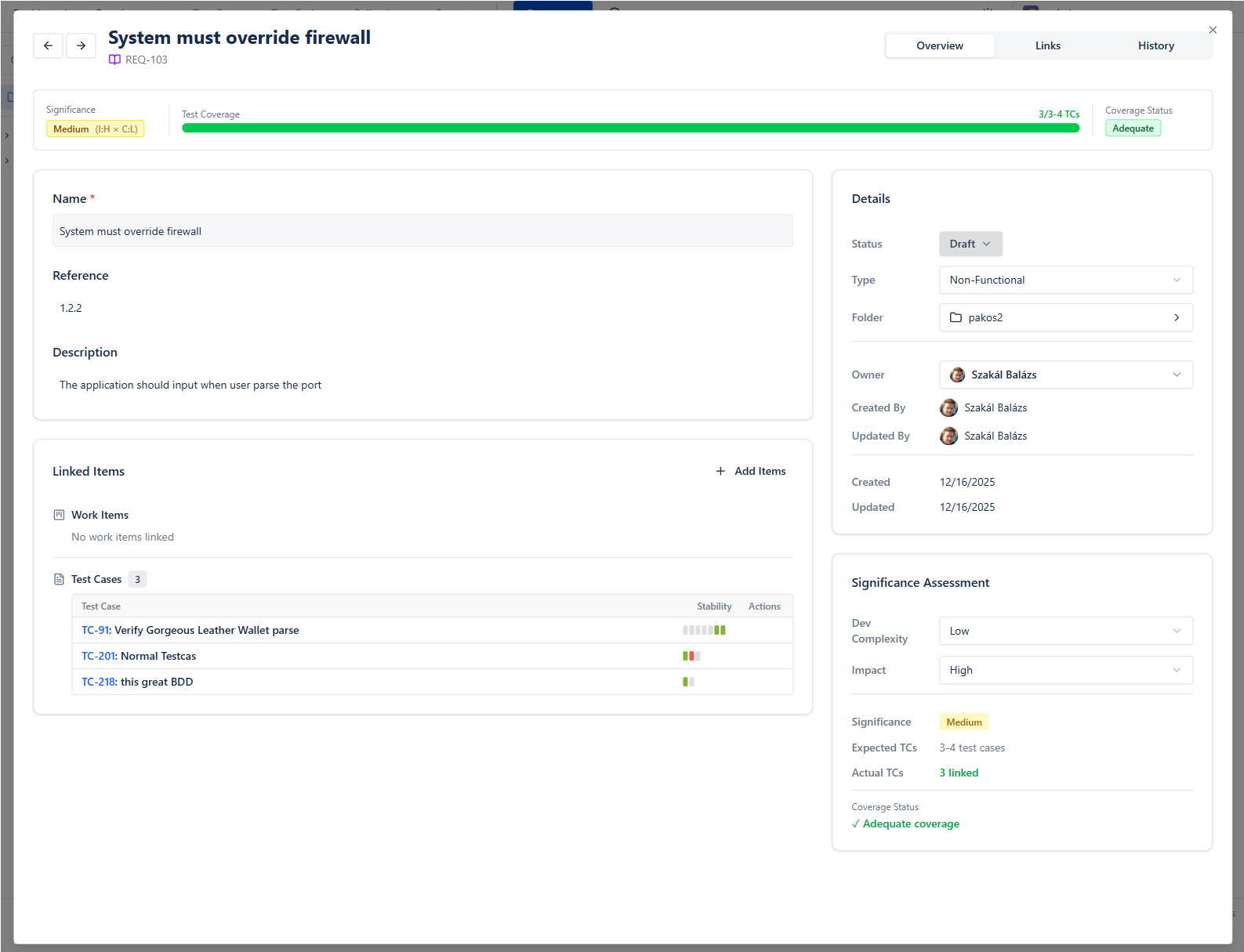
BesTest's coverage model derives each requirement's significance from its business impact and its complexity - the same likelihood-times-impact thinking risk-based testing uses to prioritize effort. A Critical requirement needs eight linked test cases to count as Covered and a Low one needs one, so risk gaps surface automatically.
Implement Risk-Based Testing with BesTest
Set significance on each requirement
Open a requirement in BesTest and set its Impact and Complexity (Low, Medium or High). BesTest turns the pair into a significance of Low, Medium, High or Critical. A payment processing requirement with high complexity and high impact is Critical and needs eight linked test cases to be Covered; a cosmetic label change is Low and needs one.
List the highest-risk gaps
Filter the requirements catalog to the gaps, for example significance IN ("CRITICAL", "HIGH") AND coverage IN ("NOT_COVERED", "PARTLY_COVERED"), or put the Significance Coverage Matrix gadget on a Jira dashboard. Critical and High requirements that are Partly covered or Not covered are your highest-risk gaps. This is your prioritized testing backlog - no risk assessment spreadsheet needed, because the data already lives in BesTest.
Prioritize test creation for uncovered high-significance requirements
Start writing test cases for the highest-significance gaps first. The Coverage card on each requirement shows exactly where it stands ("Test cases: 3 linked of 5 needed"), and Create & Link adds new test cases already linked. Each test case you add moves the requirement closer to Covered. If the team decides fewer tests are enough, a person can set the Decision to Covered, and a hand icon shows it was a human call.
Use Smart Collections to auto-include high-priority tests
Create a Smart Collection with rules that filter by priority, type or folder, and add your Critical and High requirements in its Requirements tab. When you run a risk-focused test cycle before a release, adding the collection brings in the right tests. As new high-priority test cases are created, they appear in future cycles without manual intervention.
Review coverage before release
Before signing off on a release, open the Requirements Traceability Matrix report with stakeholders: every requirement with its linked tests, latest results, linked bugs and a High / Medium / Low risk level. For a single epic, the Work Item Traceability report gives the same readiness view. If any Critical requirement is still under-tested, the team knows exactly where the risk is - and can make an informed go/no-go decision with data, not gut feel.
Built for Risk-Based Testing
Significance comes from impact and complexity, the core risk-based testing idea, built into every requirement - no extra plugins, no custom fields.
Every requirement is Covered, Partly covered or Not covered relative to its significance, and the same value drives the catalog, filters, reports and dashboard gadgets. Under-tested high-risk areas stand out.
Coverage reports and the Significance Coverage Matrix give stakeholders transparent visibility into where testing effort is concentrated and where gaps remain, supporting data-driven release decisions.
Smart Collections assemble test suites from filter rules (priority, type, folder, custom fields) and linked requirements - creating targeted risk-based test cycles without manual curation.
Related Resources
- How to Write Test Cases: The Complete 2026 GuideGuide
- Test Management in Jira: The Complete 2026 GuideGuide
- Regression Testing in JiraUse case
- Smoke Testing in JiraUse case
- Security Testing Management in JiraUse case
- Test CoverageDefinition
- Requirements TraceabilityDefinition
- Test PlanDefinition
- Test StrategyDefinition
- Regression TestingDefinition
- Smoke TestingDefinition
- Test ScenarioDefinition
Ready to try BesTest?
Apply risk-based testing with a tool that supports your methodology natively inside Jira. Free for up to 10 users.
Get BesTest Free