Who This Comparison Is For
If you run testing in Jira Cloud and are deciding which test management app to install - or whether to replace the one you have - this comparison is for you. We put six leading tools side by side and judged them on the same five things: where test data lives (Jira issues or a separate database), the platform they are built on, core features including requirements traceability, how native the experience feels inside Jira, and how pricing scales with your team.
Updated 14 October 2026: prices re-checked against the Atlassian Marketplace, a new row for MCP servers (three of the six tools now have an official one), and the BesTest section rewritten for its October release.
We are the makers of BesTest. We list it first because we know it best, not because it wins every category - each tool here has a defensible position, and we say who should pick the others. Trial your top two before committing.
The tools covered:
 BesTest
What it is: A Jira app for requirement and test management, built on Atlassian Forge. Requirements, test cases, and executions are BesTest's own records rather than Jira issues, so Jira stays fast however much you test, and you still open everything from inside Jira.
Key features:
- •Built-in requirements with significance-weighted coverage: each requirement reads Covered, Partly covered, or Not covered, judged against how many linked test cases its significance (impact x complexity) needs. A person can override the decision.
- •Review and approval for both test cases and requirements: reviewers, a note, a due date, review rounds, and a review audit trail
- •Test cases with folders, step-by-step or BDD (Gherkin) format, and custom fields; bulk create test cases and requirements (one name per line), also from the Jira work item panel
- •Test Player with search, My work, filters, Next to do, and reruns; it tells you when a test case changed after the run started
- •Smart Collections - reusable test sets built from folder, field, and BQL rules plus linked requirements, re-evaluated every time you add them to a cycle
- •BQL, a JQL-like query language with autocomplete and ORDER BY
- •Requirements Traceability Matrix, release readiness on every Jira work item (coverage, pass rate, open bugs, risk level), Jira dashboard gadgets
- •REST API and MCP server, with self-service tokens
- •Data hosted in the EU, US, or India; 1-click enable per Jira project
- •Coming soon: advanced reporting with data sets and custom reports
Pros:
- •Zero Jira issue bloat - test data lives outside the issue system
- •Requirements are first-class records with real coverage, not borrowed Jira stories
- •Smart Collections and BQL remove most manual test cycle assembly
- •Free for up to 10 users with every feature
- •Set up in about a minute; the UI follows the Atlassian Design System
Cons:
- •Younger product with a much smaller install base than Zephyr or Xray
- •No file attachments yet - evidence goes on a linked Jira work item - and no test case version history yet
- •No shared steps or parameterized test data
- •The REST API and MCP server are new, and there are no dedicated CI plugins; pipelines post results through the API
- •Cloud only
Pricing: Free for up to 10 users. $1.79 per user per month for 11-100 users, cheaper per user beyond that.
Verdict: Choose BesTest if you want requirements and test cases linked in one Jira app without issue bloat - especially if you are starting fresh, escaping spreadsheets, or running UAT with business reviewers. Hold off if you need attachments on test runs or pre-built CI plugins today. You can click through the real app without installing anything in the live demo.
 Zephyr Scale
What it is: The most established test management app for Jira, owned by SmartBear (formerly TM4J, now branded simply "Zephyr"). It started on Connect, now runs as Connect on Forge, and keeps test data in its own store, so no issue bloat.
Key features: Test cycles and plans, parameterized test cases and data sets, traceability to Jira issues, REST API for CI/CD, reporting and custom dashboards, cross-project test reuse, strong import/export, and an MCP integration through the SmartBear MCP Server.
Pros:
- •Battle-tested at enterprise scale, with the largest community and documentation base
- •Mature automation and CI/CD integration
- •Well-supported migration paths from other tools
Cons:
- •No built-in requirements management - you link to Jira issues instead
- •Its own UI conventions; noticeably not Jira
- •Among the pricier options per user, and the feature depth is overkill for small teams
Pricing: $10 per month for up to 10 users, then $6.81 per user per month for 11-100 users (Marketplace list price, monthly billing).
Verdict: Choose Zephyr Scale if you are an enterprise with established CI/CD automation and you want the vendor nobody gets fired for picking. If built-in requirements management matters, look at BesTest or RTM instead.
See the full BesTest vs Zephyr Scale comparison | Looking for a Zephyr Scale alternative?
 Xray
Xray
What it is: A comprehensive test management tool (part of Idera) that stores every test, execution, plan, and set as a Jira issue. That gives you full JQL power over test data - and adds thousands of issues to your Jira instance.
Key features: All test entities as Jira issue types with full JQL support, BDD/Cucumber integration, CI/CD integration (Jenkins, Bamboo, GitLab, and more), REST and GraphQL APIs, requirement coverage analysis, parameterized testing, and in-app AI test case generation.
Pros:
- •The strongest automation and BDD/Cucumber support in the category
- •Full JQL access to all test data - powerful if your team lives in JQL
- •Deep CI/CD pipeline integration, comprehensive documentation, active community
Cons:
- •Issue bloat - every test artifact is a Jira issue, which weighs on performance at scale and clutters backlogs, boards, and searches
- •Steeper learning curve across multiple custom issue types
- •Now the most expensive Marketplace app in this list at 100 users, and full automation pipelines take real setup effort
Pricing: $10 per month for up to 10 users, then $7.28 per user per month for 11-100 users (Marketplace list price, monthly billing). Our Xray pricing breakdown has every tier.
Verdict: Choose Xray if you have existing Cucumber/BDD automation or a serious CI/CD pipeline and can live with the issue bloat it creates in Jira. If your testing is mostly manual, you are paying Xray's complexity tax for power you will not use.
See the full BesTest vs Xray comparison | Looking for an Xray alternative?
 AIO Tests
What it is: An affordable all-in-one test management app by Navarambh Software, with separate storage, so no issue bloat.
Key features: Test cases with folders, test cycles, bulk operations, traceability to Jira issues, CSV/Excel import, 20+ reports, REST API and automation connectors, BDD support, AI-assisted test case creation, and an official hosted MCP server (launched May 2026, focused on test cases).
Pros:
- •One of the most affordable options, with a free tier up to 10 users
- •Lots of features for the price, including in-app AI
- •Good import capabilities and a responsive support team
Cons:
- •No built-in requirements management
- •No dedicated test case review workflow, and no rule-based collections
- •Dense screens that look like a separate tool rather than part of Jira
Pricing: Free for up to 10 users, then $2.30 per user per month for 11-100 users.
Verdict: Choose AIO Tests if budget decides and your needs are test cases, cycles, reports, and in-app AI. The day you need requirements traceability or rule-based test cycles, you will be shopping again.
See the full BesTest vs AIO Tests comparison | Looking for an AIO Tests alternative?
 Requirements and Test Management for Jira (RTM)
What it is: A test management app by Deviniti that, like Xray, stores everything as Jira issues - but adds built-in requirements management alongside tests.
Key features: Requirements (several types) and test cases as Jira issue types, traceability matrix, coverage analysis, test plans and executions, full JQL support, Jira-native workflows, REST API, import/export.
Pros:
- •Built-in requirements management - one of only two tools here that has it
- •Full JQL access to requirements and test data
- •Uses Jira's own workflows; no separate workflow engine to learn
Cons:
- •Issue bloat - every requirement, test, and execution is a Jira issue
- •Less sophisticated reporting; UI feels dated in places
- •Smaller user base and community than Zephyr or Xray
Pricing: $8 per month for up to 10 users, then $2.01 per user per month for 11-100 users.
Verdict: Choose RTM if JQL access to requirements is a hard requirement and you accept that every requirement and test becomes a Jira issue. If you want the same requirements-plus-tests pairing without the bloat, that gap is exactly what BesTest fills.
See the full BesTest vs RTM comparison | Looking for an RTM alternative?
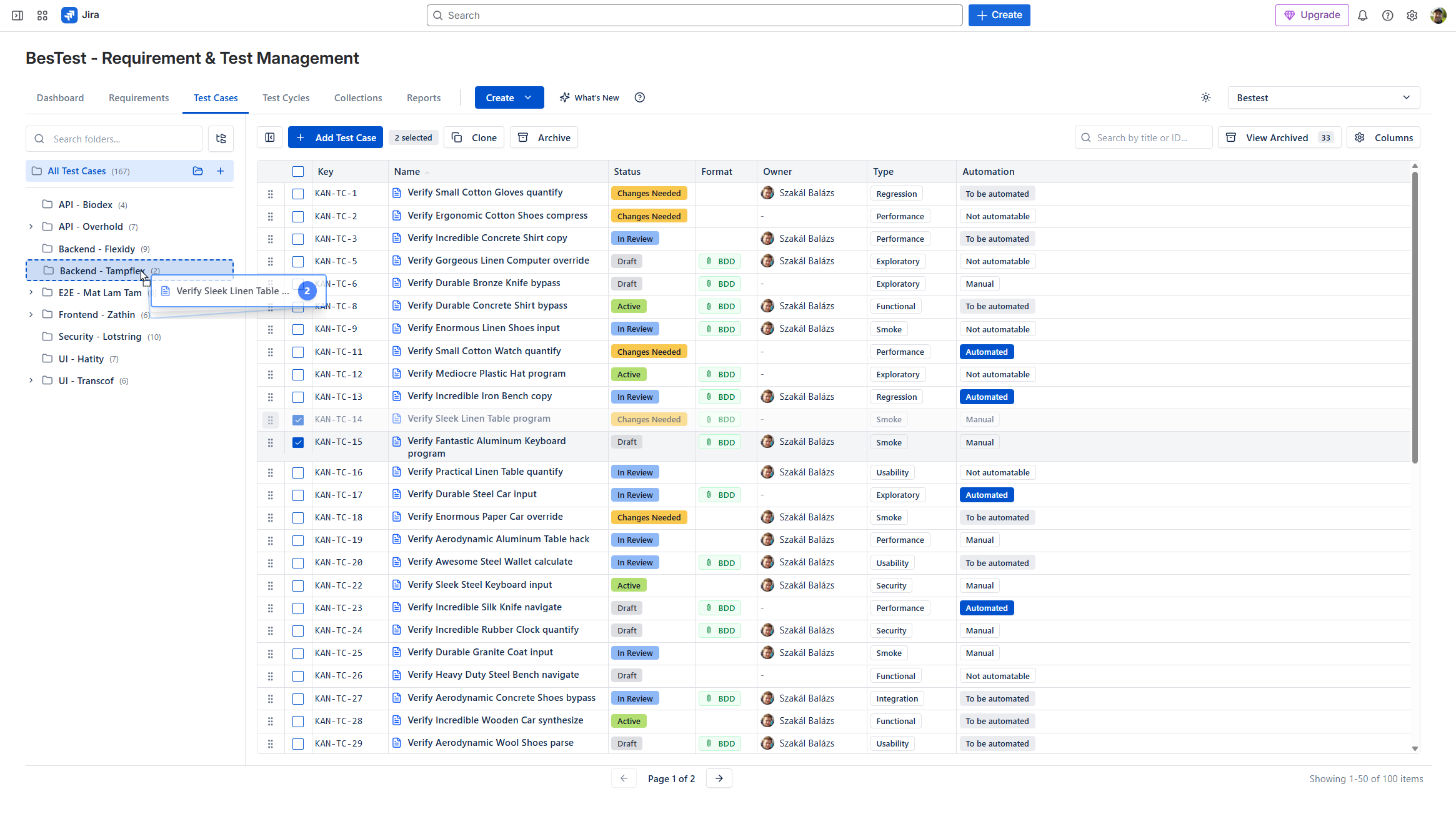
Live preview - this is the real BesTest UI
Six tools compared. The one you keep is the one your team opens.
A comparison table can rank features, but it cannot tell you which tool your testers will still be using in March. The cheapest way to find out is to run one real cycle in one. BesTest is a Jira app rather than a separate tool, so that trial costs a project toggle and about a minute: built-in requirements with significance-based coverage, test case and requirement reviews, Smart Collections, BQL search, and no Jira issue bloat. The REST API and MCP server are in open beta. Free for up to 10 users.
View on the Atlassian Marketplace TestRail
What it is: A standalone test management platform originally built by Gurock and part of the Idera group since 2016. Not a Jira app - a separate application with a Jira integration that is not embedded in Jira's UI.
Key features: Test cases with sections and suites, a BDD template, test runs and plans, milestones, comprehensive reporting, REST API and CI/CD integration, custom fields and templates, test case approvals on the Enterprise plan, cloud or on-premises deployment.
Pros:
- •Extremely mature and feature-rich, with a large ecosystem of integrations
- •Excellent reporting and analytics
- •On-premises option; works even if you leave Jira
Cons:
- •Lives outside Jira - separate login, separate user management, constant tool switching
- •A separate licence on top of Jira, with no free tier
- •UI is functional but showing its age
Pricing: Per-user pricing with cloud and server options, bought outside the Atlassian Marketplace. No free tier - trial only.
Verdict: Choose TestRail if Jira is just one tool among many for you, you might switch issue trackers, or you need on-premises deployment. If your team lives in Jira all day, the constant context switch will wear them down.
See the full BesTest vs TestRail comparison | Looking for a TestRail alternative?
Side-by-Side Comparison
| Criteria | BesTest | Zephyr Scale | Xray | AIO Tests | RTM | TestRail |
|---|---|---|---|---|---|---|
| Platform | Forge | Connect on Forge | Connect on Forge | Connect | Forge Remote | Standalone |
| Data Storage | Separate (dedicated DB) | Separate (SmartBear) | Jira Issues | Separate | Jira Issues | Standalone DB |
| Issue Bloat | None | None | Yes | None | Yes | N/A |
| Built-in Requirements | Yes | No | No | No | Yes | No |
| Test Case Review | Yes (test cases and requirements) | Status field | Via Jira workflows | No | Via Jira workflows | Enterprise plan |
| Rule-based Collections | Yes (Smart Collections) | No | No | No | No | No |
| Test Player | Yes | Yes | Yes | Yes | Yes | Yes |
| BDD Support | Yes | Yes | Yes | Yes | No | Yes |
| REST API | Yes | Yes | Yes | Yes | Yes | Yes |
| CI/CD Integration | Via REST API | Yes | Yes | Yes | Limited | Yes |
| Official MCP Server | Yes | Yes (SmartBear MCP Server) | No | Yes (test cases) | No | No |
| Query Language | BQL | No | JQL (via issues) | No | JQL (via issues) | No |
| Free Tier | Up to 10 users | No ($10/mo for 10) | No ($10/mo for 10) | Up to 10 users | No ($8/mo for 10) | No (trial) |
| Price per user at 100 users | $1.79 | $6.81 | $7.28 | $2.30 | $2.01 | Separate licence |
| On-Premises | No | Data Center | Data Center | Data Center | Data Center | Yes |
| Jira-Native UI | Yes (Forge) | Partial | Yes (issues) | Partial | Yes (issues) | No |
| Maturity | Newer | Established | Established | Mid | Mid | Veteran |
Prices are Atlassian Marketplace list prices for Jira Cloud on monthly billing, checked on 14 October 2026; annual billing is roughly 17% cheaper. Marketplace apps are billed for every Jira user on the site, not only your testers. "No" in the MCP row means no official server; community-built servers exist for most tools.
Key takeaways from the table:
- •If you want a clean Jira: BesTest, Zephyr Scale, and AIO Tests store test data separately. Xray and RTM add every test artifact as a Jira issue.
- •If you need CI/CD now: Zephyr Scale, Xray, and TestRail have the most mature pipeline integrations. BesTest covers automation through its REST API (open beta).
- •If you want AI agents on your test data: BesTest, Zephyr, and AIO Tests have official MCP servers. Scope differs, so check what each one exposes: BesTest's covers requirements, test cases, cycles, and executions.
- •If you need query power over test data: Xray and RTM give you JQL (with the bloat trade-off). BesTest's BQL gives JQL-like search without storing tests as issues.
- •If budget is tight: BesTest and AIO Tests are free for up to 10 users. Above that, the per-user price at 100 users ranges from $1.79 to $7.28.
- •If you need built-in requirements: BesTest and RTM are the only options.
- •If you might leave Jira: TestRail is the safest bet as a standalone platform.
How to Choose: Our Decision Framework
Use the same criteria the tools were judged on, in this order:
1. Decide where test data should live. This is the most consequential call, because migrating later is painful.
- •Want Jira to stay clean? Separate-storage tools: BesTest, Zephyr Scale, or AIO Tests.
- •Need JQL over test data? Xray or RTM - and accept the issue bloat. BesTest's BQL is the middle path: JQL-like search without issues.
- •Need a platform independent of Jira? TestRail.
Match the tool to your workflow.
- •Heavy CI/CD automation today: Xray or Zephyr Scale
- •BDD/Cucumber automation: Xray
- •Requirements traceability built in: BesTest or RTM
- •Formal sign-off before execution (UAT, regulated teams): BesTest, or TestRail Enterprise
- •Quick setup, low overhead: BesTest or AIO Tests
- •On-premises: TestRail, or the Data Center editions. Regional cloud hosting: BesTest offers the EU, US, or India.
3. Price it at your actual Jira user count. Up to 10 users, BesTest and AIO Tests are free - start there. Beyond that, calculate the annual cost at your user count, not your tester count, before falling in love with a feature list.
4. Run a real trial, not a feature-list bake-off. Install your top two candidates, create 20-30 test cases that reflect actual work, execute a mini cycle, and generate the report your stakeholders actually ask for. The tool that fits how your team works beats the one with the longest feature list.
If you are migrating from another tool: check import support first. BesTest imports test cases and requirements from CSV or Excel and can keep the links between them with a two-pass import; our guides for leaving Xray and leaving Zephyr Scale walk through it. Migrate only active test cases, and budget a few weeks with a parallel-run period.
Conclusion
There is no single best Jira test management tool in 2026, but there are clear lanes:
- •BesTest - requirements and tests linked in one Jira app, no issue bloat, free up to 10 users. The strongest fresh start.
- •Zephyr Scale - the safe enterprise default with mature automation and the biggest community.
- •Xray - the automation and BDD powerhouse, if you accept the issue bloat and the price.
- •AIO Tests - the budget pick with plenty of in-app AI, if you do not need requirements.
- •RTM - requirements plus tests inside the Jira issue model, JQL included.
- •TestRail - the standalone veteran for teams not married to Jira.
Pick your lane, trial the top two against a real sprint, and choose the one your testers stop complaining about.
Frequently Asked Questions
What is the difference between Forge and Connect apps for Jira?
Forge apps are built on Atlassian's app platform and benefit from its security features like sandboxing, identity management, and built-in permissions. Connect apps run on the vendor's own servers and communicate with Jira via API. Forge is Atlassian's recommended platform for new apps, and with Connect reaching end-of-support in 2026 the established tools are migrating over (Xray and Zephyr via Connect on Forge, RTM via Forge Remote). BesTest was built on Forge from day one rather than migrated to it.
What is Jira issue bloat and which tools cause it?
Issue bloat occurs when a test management tool stores test cases, executions, and results as Jira issues. With thousands of test cases and regular execution cycles, this can add tens of thousands of issues to your Jira instance, slowing searches, cluttering backlogs, and degrading performance. Xray and RTM use this approach. BesTest, Zephyr Scale, and AIO Tests store data separately to avoid bloat. TestRail is standalone and does not affect Jira's issue count at all.
Which Jira test management tools have an MCP server?
As of October 2026, three of the six tools in this comparison have an official MCP server: BesTest (covering requirements, test cases, cycles, and executions, with self-service tokens), Zephyr (through the SmartBear MCP Server), and AIO Tests (launched May 2026, focused on test cases). Xray, RTM, and TestRail have community-built MCP servers but no official one.
Can I migrate test cases between these tools?
Yes. Most tools import from CSV and Excel, which works as a common interchange format, and most have REST APIs that can be scripted for bulk transfers. BesTest imports both test cases and requirements and can rebuild the links between them with a two-pass import. Migrate active test cases first, verify a small batch, and plan a parallel run of a few weeks. Execution history is usually best left in the old tool as an archive.
Which tool is best for teams that also need requirements management?
BesTest and RTM both include built-in requirements management. BesTest weighs coverage by significance (impact x complexity): each requirement reads Covered, Partly covered, or Not covered depending on whether it has enough linked test cases for how much it matters, and a person can override the decision. Requirements can also go through review and approval before test cases are written. RTM stores requirements as Jira issues, giving you JQL access but contributing to bloat. The other tools link to existing Jira stories for traceability.
Is there a free Jira test management tool?
BesTest and AIO Tests are free for up to 10 users, permanently - the only tools in this comparison with a lasting free tier. Zephyr and Xray cost $10 per month for up to 10 users and RTM costs $8, all with a free trial first. TestRail offers a trial only. For a team of 10 or fewer that wants requirements and test management together at no cost, BesTest is the option.
What is BQL in BesTest?
BQL stands for BesTest Query Language. It works like Jira's JQL: field, operator, and value, combined with AND/OR and parentheses, with ORDER BY for sorting and autocomplete as you type. You use it to filter test cases, requirements, and other records, and to define Smart Collection rules - JQL-style search without storing test data as Jira issues.
Do I need CI/CD integration in my test management tool?
It depends on your testing maturity. If your team runs automated tests in CI/CD pipelines and wants results reported back into the test management tool, then yes. Xray, Zephyr Scale, and TestRail have the most mature pipeline plugins. BesTest offers a REST API and an MCP server, and you create the token yourself in the app. If your team mostly tests manually or is just starting with test management, CI/CD integration is something you can adopt later.
Six tools compared. The one you keep is the one your team opens.
A comparison table can rank features, but it cannot tell you which tool your testers will still be using in March. The cheapest way to find out is to run one real cycle in one. BesTest is a Jira app rather than a separate tool, so that trial costs a project toggle and about a minute: built-in requirements with significance-based coverage, test case and requirement reviews, Smart Collections, BQL search, and no Jira issue bloat. The REST API and MCP server are in open beta. Free for up to 10 users.
View on the Atlassian Marketplace
Balázs Szakál
Founder & QA Lead at BesTest
Founder of BesTest and QA professional with extensive experience in software testing, test management, and Jira administration. Built BesTest to give testing teams complete visibility from requirements to release.
More about the team →